The Evidence Behind the Estimate: Auditing Progress in Precision Supply

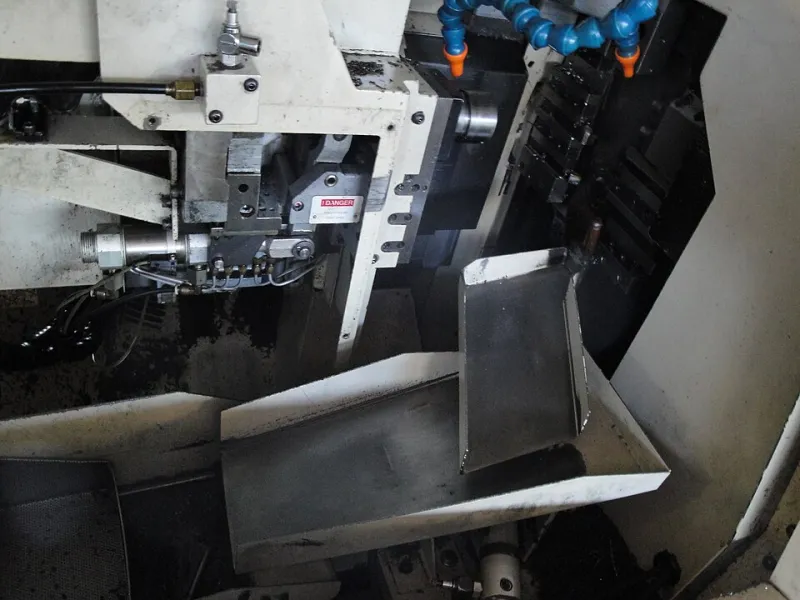
Photo: Jaggery , CC BY-SA 2.0, via Wikimedia Commons
A call is not a control
In UK precision subcontracting, progress is often communicated through a weekly call, a brief email and a slide or two. The supplier reports that the job is 'on track', that the material has arrived, that the first operation is nearly complete. These updates are not usually dishonest. They are simply easier to produce than evidence. For the buyer, however, an update that cannot be checked is not a control. It is a forecast wearing a status report's clothes. The distinction matters most when lead times are tight, revisions are live and downstream operations depend on a single set-up.
A credible schedule is not a prediction of what might happen. It is a record of commitments made, evidence supplied and exceptions declared. Buyers who specify progress reporting in those terms get something more useful than reassurance: they get an audit trail.
Separate activity from advancement
A busy shop is not necessarily a progressing job. Machines may be running on another customer's work. The correct operation may be queued behind a late tool. The parts may be at the right stage but to the wrong drawing revision. Progress should therefore be defined as verified movement from one named state to another, not as general industrial activity.
For each milestone, the buyer and supplier should agree four fields: the operation or stage, the quantity and identity of parts, the physical location, and the evidence reference. A useful entry might read: 120 of 120 blanks roughed on machine M-04, job card JC-2214, first-off dimensional report FD-118, material heat number H-4471. This is not bureaucracy. It is the minimum needed to distinguish a commitment from a hope.
Put evidence at the milestone gate
Progress claims should be tied to evidence gates. At the end of rough machining, for example, the supplier might provide a completed operation count, a first-off inspection record and confirmation that the next operation is booked. At the end of finishing, the evidence might include a certificate of conformity, a surface texture report and a nonconformance status. The gate need not be a full inspection pack. It should be sufficient to prove the claimed state.
Buyers should specify the evidence in the purchase order or schedule agreement, not request it after a missed date. The wording can be proportionate: 'At each milestone, supplier shall provide the agreed evidence set within one working day of completion.' That single clause changes the conversation. The question becomes not 'do you believe me?' but 'where is the record?'
Make machine time visible without demanding a live feed
Not every UK precision supplier has machine monitoring, and buyers should not demand a live data feed as a proxy for control. A proportionate alternative is a weekly extract from production control showing work centre, job number, planned versus actual hours, set-up and run status, and downtime reason. If the extract is manual, it should be signed by the production supervisor. For critical parts, time-stamped photographs at set-up sign-off or in-process inspection can close the gap between a job card and the shop floor.
The principle is visibility, not surveillance. The buyer needs to know whether the claimed operation actually consumed machine time and whether the next operation is realistically resourced. A report that shows a job 'in progress' for three weeks without a work centre, hours booked or operation sequence is not visibility. It is a narrative.
Define exception triggers in advance
A schedule is most vulnerable at the moment an exception is discovered. Too often, the buyer learns of a problem only when the delivery date is already lost. The reporting model should therefore include triggers that require notification within an agreed period, typically twenty-four to forty-eight hours.
Useful triggers include slippage of more than three working days against a critical-path milestone, yield below an agreed threshold, missing material certification, unplanned downtime on a constrained machine, a subcontractor delay, or a drawing revision that affects work already completed. The notification should state the cause, the impact on the schedule, the recovery action and the revised commitment. A revised date without a named action is a new forecast, not a recovery plan.
Turn the weekly report into an audit trail
A practical weekly report has five sections: milestone status, evidence references, open exceptions, recovery actions and next-week commitments. Status can be simple red, amber or green, but it must be supported by the evidence column. The report should be version-controlled, signed off by a named supplier contact and retained with the purchase order. It should not be a slide deck that disappears into a inbox.
This format also protects the supplier. It creates a shared record of what was agreed, what was delivered and what changed. When a buyer later asks why a date moved, the answer is in the trail rather than in memory.
Apply the model in proportion to risk
Not every part needs the same rigour. A low-risk standard component might need a monthly summary and a certificate at dispatch. A medium-risk machined part might need weekly reporting with machine-time extracts. A high-risk, long-lead or safety-critical item might need gate evidence, daily exception reporting and a named recovery owner. The tiering should be written into the supplier agreement and reviewed as risk changes.
The aim is not to bury precision suppliers in administration. It is to make the reporting burden match the consequence of failure. A buyer who asks for everything will often receive nothing that can be checked.
The schedule as a trail, not a story
In precision manufacturing, the part is proven by measurement. Progress should be proven in the same spirit. A weekly call can be useful for relationship and judgement, but it cannot replace evidence. Buyers should specify what progress looks like, what evidence proves it and what happens when it slips. At Brimic Engineering, the principle is simple: precision manufacturing is proven in every part, and progress should be proven in every report.